Monday, August 12, 2013

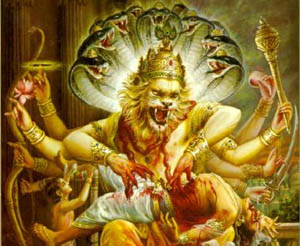
Lord Narasimha

Lord Narasimha is fourth incarnation of Lord Maha Vishnu. Narasimha is in the form of Half Man and Half Lion, and is considered as the most ugra form of Vishnu's form. This form is having a human-like torso and a lower body, but with a lion-like face and claws with ugra form. He is believed as protector of devotees all the time. Lord Narasimha took birth on earth to demolish Hiranyakashipu, the cruel asura who was considered Lord Vishnu as his moral enemy. He was brother of Hiranyaksha, the asura who was killed by Vishnu. Hiranyakashipu, thus challenging Vishnu and decided to kill vishnu's followers. He was torturing all of devas and his own villagers those are worshipping vishnu. He was forcing all of them to worship him, instead of Vishnu. His son, Prahlada was one of the devotees of Vishnu. Hiranyakashipu started challenging lord vishnu and threatening the world by his evil acts. Since he found his son himself with Vishnu's side, he decided to kill his son. Whenever he tries to kill his son, Lord vishnu was protecting him with his maya. Hiranyakashipu with utter anger asked Prahlada to show his lord. He said, Lord vishnu is in every where, even in the pillar right besides him. He thrashed the pillar into pieces and challenged him. Lord Narasimha came out from the pillar and killed the asura demon.

Ugra Narasimha, Krodha Narasimha, Malola Narasimha, Jwala Narasimha, Varaha Narasimha, Bhargava Narasimha, Karanja Narasimha, Yoga Narasimha, Lakshmi Narasimha, Chhatravata Narasimha / Pavana Narasimha / Pamuleti Narasimha are the main narasimha deities, known as "Navanarasimha".

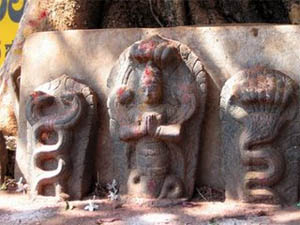
Nagas

According to Indian culture snakes are also considered as gods. ‘Nagas’ or ‘Sarppas’ means snakes. Usually we considers a naga as a king cobra. There are more importance for this ‘Nagas’ in our epics. Many stories are written about them. One of the very famous snake in our epic ‘Mahabharatha’ is ‘Anantha’, on that snake Lord Mahavishnu is laying. Great enemy of Nagas in the epics is Garuda, the vehicle of Vishnu.

Main offering to nagas are "Paalum, noorum". This can be offered in almost all naga temples in kerala.

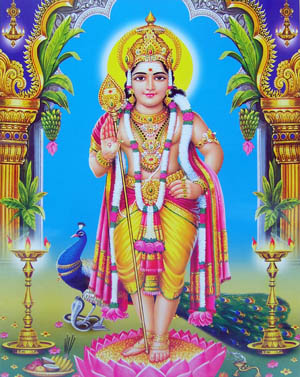
Muruga

Muruga or Subramanya is a popular deity among Hindus, especially among Tamil people. Many names are there for Muruga as Karthikeya, Kumara, Velayudha, Shanmugha and so on. His main weapon is known as ‘Vel’, which was given by Parvathy. Thus known as Velayudha. He was born as the second son of Lord Siva and Goddess Parvathy. But he was brought up by six mothers known as Krithika devis, hence he known as Karthikeyan. The intension of the birth of Muruga was to kill ‘Tharaka’, the crude and cruel asura. Its believed that he has six faces. Peacock is the vehicle of Muruga. Valli and Devayani are the two wives of Muruga. He is known as the God of War . One speciality of Lord Muruga is that he will always be young and handsome.

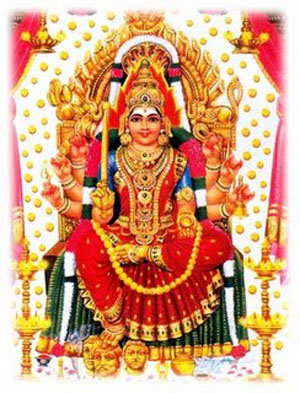
Mariyamman

Mariyamman is one of the famous goddess worshipped mainly in south india. ‘Amman’ in tamil means ‘Mother’, “Mari” means rain. Put together, meaning of ‘Mariamman’ is supposed to be the goddess of rain. This Goddess is worshipped commonly in south Indian states like Tamilnadu, Karnataka, Andhra Pradesh and some parts of Kerala too. Mother ‘Mari’ is related to our well known goddess Durga devi. Mariyamman is usually represents as an attractive lady with red dress. The word ‘mari’ has one more meaning, that is associated with disease "Pox". People considers Mariyamman as the goddess of the diseases like pox, small pox and chicken pox. The main remedy she advises for these diseases is the liquid mixture of neem and turmeric powder. We can see most of the mariyamman temples in rural areas or villages. there are non Brahmin poojaries for everyday pooja. In some temples, mariamma has no form and is only represented by a stone, with a lemon garland.

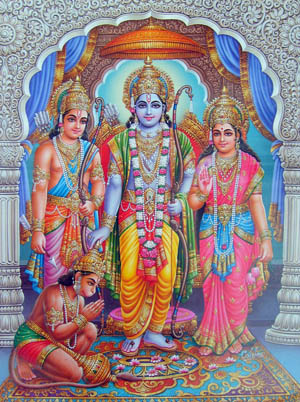
Lakshmana

Lakshmana is the brother of Lord Rama. He is also one of the close companion of Lord Rama. In Hinduism, Lakshmana is considered as the avathara of ‘Anantha’, the immortal and infinite snake on which Lord Vishnu takes rest. Lakshmana is the son of Dhasaradha’s and sumithra and twin brother of Sathrughna. In spite of of being the twin brother of Sathrughna , Lakshmana was more attached to Lord Rama. Lakshmana married to Urmila, the sister of Sita devi. Lakshmana accompanied with Rama in his entire life. He was so loyal, lovable and committed to his brother. When Rama was exiled from the country for 14 years, Lakshmana also gave up all his happiness and accompanied his brother’s foot steps. During the way also Lakshmana served Lord Rama and Sita Devi reverently. He took care of them properly during those days.
‘Lakshmana Rekha’ is very famous. It is his specialty. Intruders cant enter into the ‘Lakshmana Rekha’ or Lakshmana’s limit. If anyone crosses then they will be instantly killed. Also Lakshmana is known as a very powerful warrior. His courage and power are near to that of Lord Rama. Lakshmana is a perfect example for a man whose life represents the duties of a man to his elders. Selfishness could not be seen in any part of his life. 

Hanuman

Hanuman is one of the most important personalities in 'Ramayana'. Hanuman is known as a popular devotee of Lord Rama. His help made Rama to find out Sita devi easily and then defeat Ravana in the war. Hanuman is known as different names such as Anjaneya, Pavan puthra, Maruthi. The name 'Anjaneya' was derived from his mother's name 'Anjana', a female vanara. Its also believed that Hanuman is the incarnation of Lord Siva. So Hanuman is known as 'Maharudhra' too. Some believes that Hanuman is the son of 'Vayu', the God of wind, so having the name 'Pavan puthra'.
Hanuman meets Lord Rama when he was wandering in the forest. Rama was expelled from his country for a period of 14 years. His wife Sita and brother Lakshmana were accompanying him. But on the way, Devi Sita was kidnapped by Ravana, the king of Lanka. After their meeting Hanuman brought out an alliance between Sugriva and Lord Rama. Sugriva and his vanaras, especially Hanuman helped Rama to defeat Ravana and regain Sita. After the Ramayana war, the time came for the departure of Rama to heaven. Then every followers of Rama, excluding Hanuman decided to depart with him. But Hanuman was requested to remain on earth as an immortal sign of perfect devotee of Rama. Hanuman's version of Ramayana is known as Hanumadh Ramayana. After the war, Hanuman scripted this, when he was living in the Himalayas. But it was completely different from Valmiki's Ramayana. Its believed that,When Valmiki read 'Hanumadh Ramayana' he felt disappointed and Hanuman discarded it.

It is hanuman's speciality, that even though he is god, he always wanted to be the servant of his master, Lord Rama. Doing upasana for Hanuman is very special and auspicious and he will be protecting his devotees from all sufferings and helping for endurance in their life. It is believed that Lord Hanuman is still living with us in Kali yuga and blessing all his devotees.

Lord Dhanwanthari

Lord Dhanwanthari is an avatar of Lord Vishnu in Hindu tradition. He appears in the Vedas and Puranas as the physician of the devas. Lord Dhanwanthari is believed as the God of Ayurveda. It is common practice in Hinduism to worship Lord Dhanvantari and seeking his blessings for sound health. Dhanwanthari was one of the ancient medical adviser in India. Its believed that the first surgery was made by him. His treatments were perfectly natural. He used herbs and natural medicines for curing diseases. He could even find out the medicinal purposes of turmeric, salt and such many commonly used things. He used turmeric as an antiseptic, salt as a preservative. He is also believed to be the pioneer of modern medical practices.

In modern medical science, we use anesthetic for all the surgeries. But Dhanwanthari didn’t use anything like that for his treatment. Because of this, his methods were a lot more painful for the diseased ones. In spite of his crude methods, his treatments were knows to be successful. Dhanwanthari is depicted as Vishnu with four hands, holding medical herbs in one hand and a pot containing of ‘amritham’ in another. Birth day of Lord Dhanwanthari is celebrated every year which is two days before diwali.